


Or: Why “How are you?” is never just “How are you?” in the workplace
Contents
- Introduction: When English stops being English
- Engagement: Attention is not given, it is negotiated
- Motivation: The grammar of “why bother?”
- Feedback: The art of saying “wrong” without saying it
- Onboarding: The illusion of being “brought up to speed”
- The classroom–corporate feedback loop
- The uncomfortable synthesis: training is applied linguistics
- Conclusion: “Just a quick question” was never quick
When English stops being English
Teaching English as a foreign language looks, on the surface, like a grammar exercise in disguise. In reality, it is an apprenticeship in human behaviour.
Because once you have explained the difference between “I did it” and “I have done it” for the fiftieth time, you begin to notice something unsettlingly familiar: learners are not struggling with English. They are struggling with meaning under pressure, ambiguity under hierarchy, and confidence under scrutiny.
In other words: exactly what happens in employee training.
And just as corporate communication encodes power, uncertainty, and intent (Fairclough, 1992), so too does classroom language encode motivation, engagement, and trust.
The classroom is simply the organisation in miniature.
Or perhaps the organisation is just a very large, under-supported classroom with better coffee.
Engagement: Attention is not given, it is negotiated
In both teaching and corporate learning, engagement is often treated as a switch: either learners are engaged or they are not. Yet decades of educational research suggest a more nuanced reality. Engagement is not a fixed state but a dynamic relationship between the learner, the content, and the context in which learning occurs.
Stephen Krashen’s Input Hypothesis proposes that language acquisition occurs when learners are exposed to comprehensible input that sits just beyond their current level of competence – what he termed i+1 (Krashen, 1982). However, comprehensibility alone is insufficient. The learner must also be willing to attend to that input, process it, and connect it to an existing need or goal.
In other words, engagement is not consumption. It is consent. The quality of instruction matters, but the learner’s willingness to invest cognitive effort matters just as much.
The same principle applies in organisational learning.
Companies often invest substantial resources in training platforms, onboarding programmes, learning management systems, and professionally produced e-learning content. Yet completion rates frequently become confused with engagement, and engagement becomes confused with learning.
A beautifully designed module that no one mentally enters is merely digital wallpaper with better UX.
The hidden parallel
| Classroom | Organisation |
| “Open your books.” | “Complete this training.” |
| Attendance | Completion rate |
| Participation | Engagement |
| Learning | Behaviour change |
In both environments, the instruction itself does not guarantee attention.
This distinction is particularly relevant in modern organisations, where employees are continuously exposed to competing demands on their attention. Training does not compete only with other training; it competes with deadlines, meetings, performance targets, client requests, and the hundreds of micro-decisions that fill a typical working day.
From an organisational perspective, therefore, engagement should not be viewed as a feature of the content alone. It is also a function of relevance.
Employees are more likely to engage when they can answer three simple questions:
- Why does this matter?
- How will this help me?
- What happens if I do not learn it?
These questions mirror the concerns of language learners, who rarely study grammar for grammar’s sake. They study because they want to travel, pass an exam, obtain a promotion, relocate internationally, or participate more confidently in professional life.
Meaning drives attention.
Teaching English taught me that engagement is rarely a question of presentation quality alone. It is fundamentally a question of perceived relevance. Learners engage when they recognise value, not merely when information is available.The same is true in organisations.
Engagement is not delivery.
Engagement is uptake.
Motivation: The grammar of “why bother?”
If engagement is attention, motivation is direction. In language teaching, motivation is often divided into two broad categories:
- Integrative motivation – I want to belong to the community.
- Instrumental motivation – I need this for a job, exam, or promotion.
Most learners are driven by a combination of both. The student studying English for an international career often also wants the confidence to participate in conversations, meetings, and social situations.
The same distinction quietly exists in corporate learning. Employees may complete training because it is mandatory, but they engage more deeply when they see how it contributes to their professional growth, performance, or sense of belonging within the organisation.
Employees rarely say: “I am not motivated.”
They are more likely to say: “I’m busy.”
Which, in pragmatic terms, often means: this is not meaningful enough to prioritise.
This is where Self-Determination Theory becomes particularly relevant. Deci and Ryan argue that motivation is strongest when three needs are met: autonomy, competence, and relatedness (Deci & Ryan, 1985).
In practical terms, people are more likely to learn when they:
- have some control over the process,
- feel capable of succeeding,
- and understand how the learning connects to others and to organisational goals.
As a teacher, I found that learners progressed fastest when they could see evidence of improvement and understood why the skill mattered. The same principle applies in employee development.
Remove autonomy, competence, or relevance, and you do not usually get open resistance. You get something far more difficult to detect: polite compliance.
People attend the training, complete the module, and pass the assessment, yet little changes afterwards.
In organisational learning, that polite silence may be the most expensive sound of all.
Feedback: The art of saying “wrong” without saying it
Feedback in English teaching is a masterclass in indirectness.
A teacher rarely says: “This is incorrect.”
Instead, you get: “Have another look at this section.”
Corporate echo: “Let’s revisit this.”
This is not cowardice. It is face-saving pragmatics, as described by Brown & Levinson (1987) in their politeness theory. Penelope Brown and Stephen C. Levinson argue that communication constantly balances clarity against social harmony.
But here lies the paradox:
- Too direct → discouragement
- Too indirect → confusion
Feedback is therefore not correction. It is calibration.
Or, in corporate terms: performance optimisation with emotional risk management enabled.
Onboarding: The illusion of being “brought up to speed”
Onboarding is often treated as induction. In reality, it is translation.
New employees are not just learning tasks. They are decoding:
- implicit norms
- corporate pragmatics
- unspoken hierarchy signals
- what people actually mean when they say things
This mirrors second-language acquisition remarkably closely. When learning a language, mastering grammar and vocabulary is only the beginning. Real fluency comes from understanding context, tone, cultural expectations, and the unwritten rules that govern communication.
The same is true in organisations.
A new employee may quickly learn how to use the systems, complete the mandatory training, and follow documented processes. Yet they may still struggle to understand how decisions are made, how feedback is delivered, or when it is appropriate to challenge an idea in a meeting.
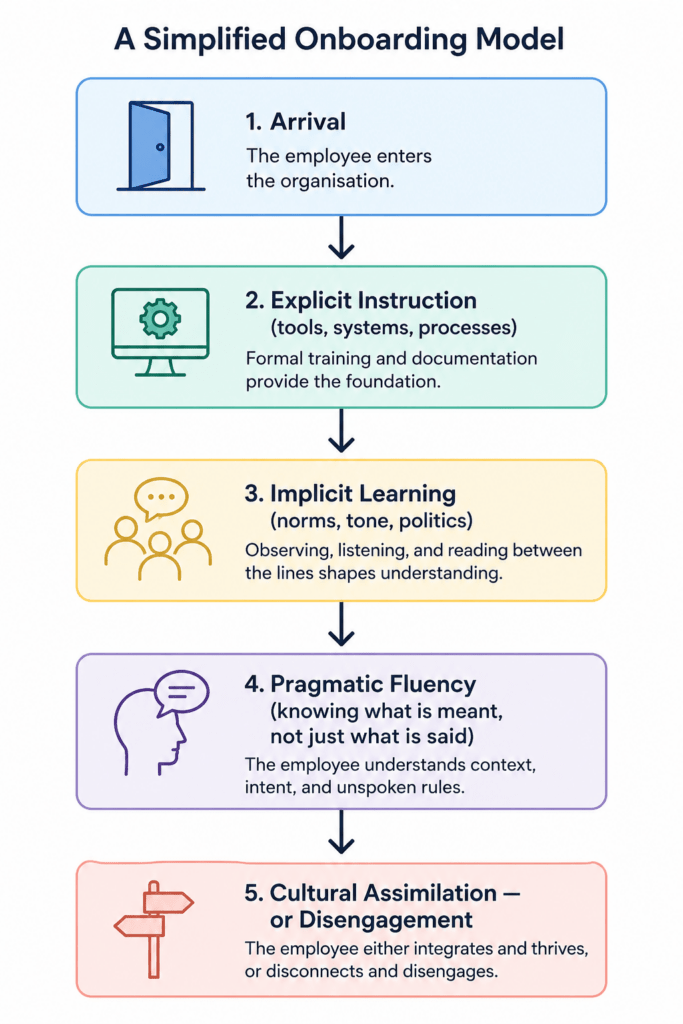
Most onboarding programmes stop at step two and assume fluency emerges naturally.
It does not.
As an English teacher, I learned that learners become confident not when they memorise rules, but when they can successfully navigate real interactions. Likewise, employees become productive not when they know the handbook, but when they understand how the organisation actually works.
For Learning & Development teams, this highlights an important distinction: onboarding is not simply a transfer of information. It is the process of helping people interpret a new organisational culture.
And culture, much like language, is rarely learned from the manual.
The classroom–corporate feedback loop
Teaching English reveals something quietly uncomfortable about employee training: both systems rely heavily on assumed comprehension. In other words, we routinely behave as though understanding has occurred simply because communication has taken place.
In linguistics, this exposes a fundamental gap between:
- what is said
- what is understood
- what is acted upon
As Grice’s Cooperative Principle suggests, communication depends on shared assumptions about relevance, clarity, and intention (Grice, 1975). The problem is that these assumptions are often not shared at all.
Grice’s insight is deceptively simple: speakers and listeners cooperate to make meaning work. Yet in real classrooms and organisations, that cooperation is fragile. We routinely overestimate how aligned understanding actually is.
Corporate training inherits this problem wholesale.
Consider how success is often measured:
- “Everyone understood the module” (did they?)
- “No questions were raised” (were they encouraged?)
- “Completion rate is 100%” (what about comprehension?)
On paper, everything appears to function. In practice, comprehension is often inferred from behaviour that does not necessarily prove understanding.
This is where teaching experience becomes particularly revealing. In a classroom, silence can feel like agreement. No questions can look like clarity. A correct answer from one student can mask confusion in ten others. The same pattern repeats in organisations, just at scale.
Silence in both contexts is rarely neutral. It can signal:
- uncertainty
- disengagement
- social caution
- or simply cognitive overload
Yet it is often recorded as absence rather than signal.
This creates a subtle but persistent loop between education and corporate training: both systems optimise for visible indicators of learning while struggling to measure invisible understanding.
The result is a familiar organisational illusion: learning appears complete because activity has been completed. But activity is not comprehension.
And silence, in both classroom and workplace, is not absence of communication. It is unverified meaning.
The uncomfortable synthesis: training is applied linguistics
If we strip away the labels, employee training is not fundamentally about knowledge transfer. It is about managing meaning under real-world constraints.
Every learning intervention in an organisation-whether onboarding, leadership development, compliance training, or performance coaching-is ultimately dealing with the same underlying problem: how people interpret information, not just whether they receive it.
This is why training so often succeeds on paper but fails in practice. Organisations measure exposure, while the real variable is interpretation.
At its core, training operates across five interdependent functions:
- Engagement (managing attention)
- Motivation (shaping willingness to act)
- Feedback (refining interpretation through correction)
- Retention (preventing cognitive decay over time)
- Onboarding (accelerating cultural and pragmatic fluency)
Seen together, these are not separate HR processes. They are linguistic and cognitive mechanisms for controlling how meaning is formed and stabilised inside an organisation.
The training stack: from information to interpretation
| Layer | Function | Linguistic equivalent | Risk if absent |
| Engagement | Attention capture | “Do I attend to this message?” | Ignored content |
| Motivation | Behavioural direction | “Do I act on it?” | Passive completion |
| Feedback | Meaning correction | “Did I interpret correctly?” | Persistent misunderstanding |
| Retention | Memory stabilisation | “Do I still remember and apply it?” | Rapid decay of learning |
| Onboarding | Cultural decoding | “Do I understand how this system speaks?” | Functional confusion |
What this table makes clear is that training is not a single event, but a layered system of interpretation management.
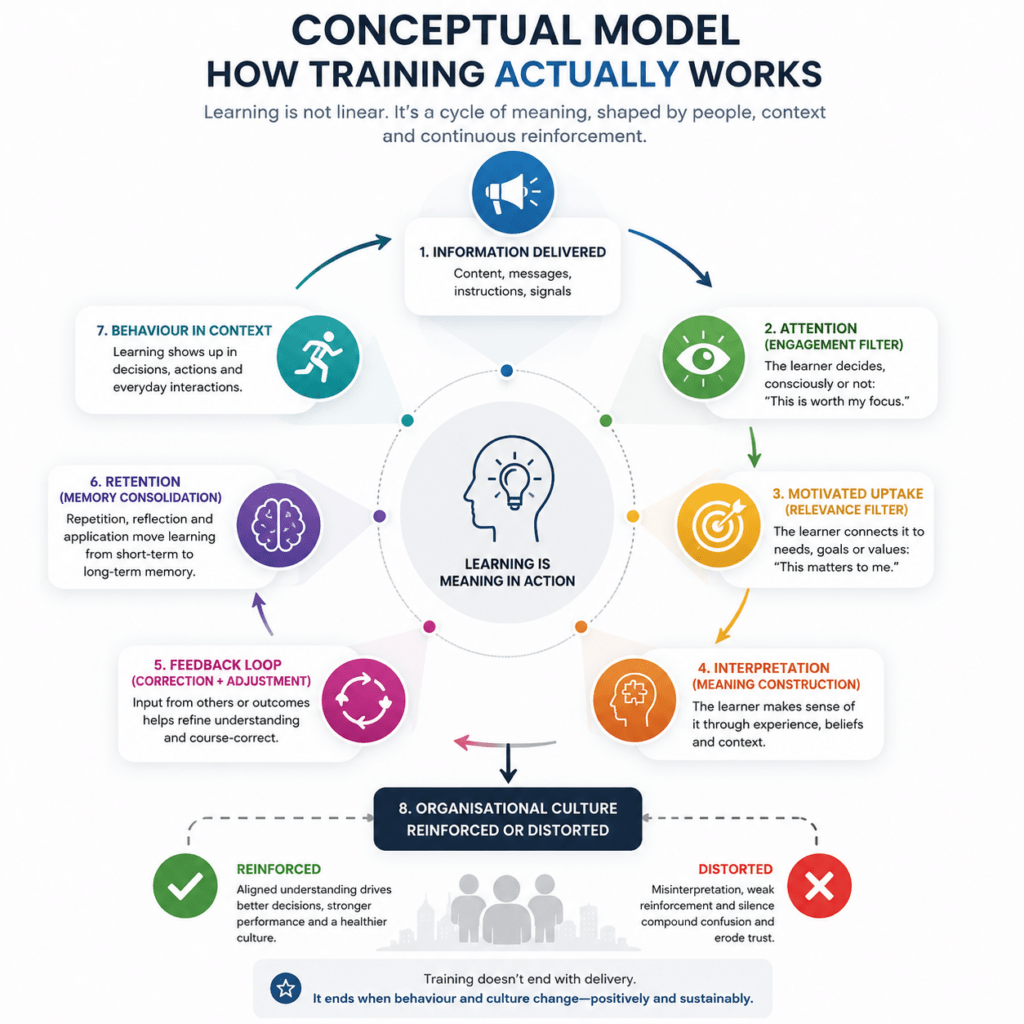
Conceptual model: how training actually works
At each stage, meaning is not transmitted intact-it is reshaped, softened, amplified, or lost.
This is why two employees can complete the same training and produce entirely different behaviours afterwards. They have not received different information; they have constructed different interpretations of the same information.
The deeper implication
Training is often framed as a content problem: “What do employees need to know?”
But in practice, it is a pragmatics problem: “How do employees interpret what they are told under time pressure, hierarchy, ambiguity, and cognitive load?”
This is why the classroom remains such a powerful analogy. In both classrooms and organisations:
- silence can be mistaken for understanding
- repetition can be mistaken for learning
- completion can be mistaken for competence
And in both systems, the most important processes are invisible: internal interpretation, social inference, and contextual decoding.
Conclusion: “Just a quick question” was never quick
Teaching English makes one thing unavoidable: meaning is never stable. It is negotiated, inferred, softened, and sometimes strategically misunderstood.
The same is true in organisations.
Corporate training fails not because people do not learn. It fails because organisations assume that saying something is the same as it being understood.
And in reality, every: “just a quick question”, “let’s circle back”, “this is clear” is doing far more pragmatic work than it appears. These are not neutral phrases. They are small acts of positioning-about time, priority, authority, and sometimes avoidance.
Perhaps the real skill of employee training is not instruction.
It is translation between what organisations say and what humans actually hear.
From an English teacher’s perspective, I stopped believing in perfect understanding a long time ago. What matters instead is whether communication survives contact with reality intact enough to act upon. That is already more fragile than most organisations like to admit.
Because once you have seen enough classrooms-and enough meetings-you realise the same thing is always happening:
People are not simply exchanging information.
They are negotiating what it is safe to mean.
And that changes everything.
I’m Eng-sighted. Are you?
References
Brown, P., & Levinson, S. C. (1987). Politeness: Some Universals in Language Usage. Cambridge University Press.
Deci, E. L., & Ryan, R. M. (1985). Intrinsic Motivation and Self-Determination in Human Behavior. Springer.
Fairclough, N. (1992). Discourse and Social Change. Polity Press.
Grice, H. P. (1975). Logic and conversation. In P. Cole & J. L. Morgan (Eds.), Syntax and Semantics 3: Speech Acts. Academic Press.
Krashen, S. D. (1982). Principles and Practice in Second Language Acquisition. Pergamon.
Hall, E. T. (1976). Beyond Culture. Anchor Books.
Hutchins, W. J., & Somers, H. L. (1992). An Introduction to Machine Translation. Academic Press.
Jenkins, J. (2014). English as a Lingua Franca in the International University. Routledge.
Hyland, K. (1998). Hedging in Scientific Research Articles. John Benjamins.
Lakoff, G. (1973). Hedges: A study in meaning criteria and the logic of fuzzy concepts. Journal of Philosophical Logic, 2(4), 458–508.
Seidlhofer, B. (2011). Understanding English as a Lingua Franca. Oxford University Press.
Goffman, E. (1959). The Presentation of Self in Everyday Life. Anchor Books.
Goffman, E. (1967). Interaction Ritual. Anchor Books.
Bargiela-Chiappini, F., & Nickerson, C. (1999). Writing Business: Genres, Media and Discourses. Longman.


Leave a Reply