

How workplace communication encodes power, uncertainty, and intent
Contents
- Why Corporate Language Matters
- What Is Corporate Language?
- The Pragmatics of the Workplace
- Indirectness, Politeness, and Power
- Common Corporate Phrases — What They Really Mean
- Language, Uncertainty, and Risk Avoidance
- The Role of Culture and Global English
- AI and the Standardisation of Corporate Speech
- Conclusion
- References
Why Corporate Language Matters
Corporate communication often appears neutral, professional, and efficient. Yet beneath its surface lies a dense layer of implicit meaning, shaped by power dynamics, social norms, and institutional expectations.
Employees rarely say exactly what they mean. Instead, they rely on shared conventions, indirect phrasing, and strategic ambiguity. Understanding this “hidden layer” is not merely a linguistic exercise – it is essential for navigating modern organisations effectively.
What Is Corporate Language?
Corporate language refers to the structured, semi-formal mode of communication that emerges within organisational settings. It is not merely “professional English”, but a regulated communicative register shaped by institutional norms, hierarchical relations, and the constant need to manage risk, clarity, and interpersonal alignment.
In essence, it sits between formal bureaucratic writing and everyday conversational speech: sufficiently standardised to ensure organisational coherence, yet flexible enough to accommodate negotiation, ambiguity, and politeness.
Where Corporate Language Lives
Corporate language is not confined to one medium. Rather, it spans a network of communicative environments:
- Written formats: emails, reports, strategy decks, performance reviews
- Spoken interaction: meetings, presentations, negotiations, feedback sessions
- Institutional documentation: HR policies, compliance frameworks, internal guidelines
- Digital workplace platforms: Slack messages, project tools, AI-generated summaries
As Bargiela-Chiappini and Nickerson (1999) argue, business communication operates as a multi-genre system, where meaning is distributed across different textual and interactional forms rather than located in any single utterance.
The Pragmatics of the Workplace
To understand corporate language, we must turn to pragmatics – the study of how meaning is constructed in context rather than encoded directly in words. According to H. P. Grice’s Cooperative Principle (1975), communication depends on shared assumptions between speaker and listener. In theory, participants aim to be clear, truthful, relevant, and concise. In practice, however -particularly in corporate environments-these principles are often strategically bent or quietly violated.
Workplace communication is rarely about transmitting pure information. It is about:
- managing relationships
- signalling intent without committing to it
- navigating hierarchy
- avoiding risk
As a result, meaning emerges not from what is said, but from what is implied, softened, or deliberately left unsaid.
When Literal Meaning Is Not the Real Message
Consider the following examples:
| Literal Statement | Pragmatic Meaning |
| “Let’s revisit this later.” | This is not a priority / I want to move on |
| “That’s an interesting point.” | I disagree, but politely |
| “We might want to consider another approach.” | Your idea is not acceptable |
| “I’ll take that away.” | I will not act on this immediately (or at all) |
| “Let’s keep this high-level.” | Avoid specifics / avoid scrutiny |
These expressions function as interactional tools, allowing speakers to maintain politeness while subtly steering outcomes.
Indirect Refusals and Softened Disagreement
Direct disagreement is relatively rare in many corporate cultures. Instead, it is reframed through indirect language:
- “I’m not sure this fully aligns with our goals.”
- “There may be some challenges with that approach.”
- “We might need to rethink this part.”
In pragmatic terms, these are face-saving strategies (Brown & Levinson, 1987), designed to:
- protect the speaker from appearing confrontational
- protect the listener from embarrassment
- preserve group cohesion
Yet the cost of this politeness is often ambiguity.
Questions That Are Not Really Questions
Many workplace questions are not genuine requests for information, but indirect directives:
| Question Form | Actual Function |
| “Can we finish this by Friday?” | Please finish this by Friday |
| “Would it be possible to update the report?” | Update the report |
| “Have you had a chance to look at this?” | Why haven’t you done this yet? |
| “Do we need to go into this level of detail?” | Stop going into detail |
These are examples of what linguists call illocutionary force – the intended function behind an utterance.
Ambiguity as a Strategic Resource
Ambiguity in corporate language is not always a flaw. It is often intentional.
Consider:
- “We’ll explore this further.”
- “This is something we’re looking into.”
- “There are ongoing discussions.”
Such phrases allow organisations to:
- avoid commitment
- delay decisions
- maintain flexibility
- reduce accountability
From a pragmatic perspective, this is a form of strategic vagueness.
The Role of Hierarchy in Meaning Construction
Hierarchy fundamentally shapes how utterances are interpreted.
The same sentence can carry different meanings depending on who says it:
| Statement | Speaker | Likely Interpretation |
| “This might need more work.” | Manager | This is not acceptable |
| “This might need more work.” | Peer | Suggestion |
| “This might need more work.” | Junior | Hesitant opinion |
Thus, meaning is co-constructed through:
- linguistic form
- speaker status
- organisational context
Silence and What Is Not Said
Pragmatics also includes absence of language.
In meetings, silence can mean:
- agreement
- disagreement (unexpressed)
- confusion
- disengagement
For example:
- No response to an email → low priority / passive resistance
- Lack of questions → not necessarily understanding
As noted in organisational communication research, non-response is itself communicative.
When Clarity Breaks Down
The reliance on implicit meaning creates a paradox:
- It preserves politeness and flexibility
- But it reduces clarity and alignment
For instance:
“Let me know if you have any questions.”
Pragmatically, this shifts responsibility to the listener.
However, many employees interpret it as:
- “I shouldn’t ask”
- “I’m expected to understand”
This leads to silent misunderstanding, one of the most common sources of workplace inefficiency.
Corporate communication is not simply about what is said, but about:
- what is implied
- what is avoided
- what is softened
- what is left open
Understanding this layer transforms communication from a surface-level skill into a form of organisational literacy.
Indirectness, Politeness, and Power
One of the defining features of corporate language is indirectness. Rarely do employees communicate in fully explicit, unambiguous terms. Instead, they rely on softened phrasing, implication, and strategic vagueness.
Why Indirectness Exists
Indirectness is not accidental, as it serves several overlapping functions:
- To maintain politeness (cf. Penelope Brown & Stephen Levinson, 1987)
- To avoid interpersonal conflict
- To protect “face” (one’s social and professional image)
- To navigate hierarchical relationships
- To reduce personal and organisational risk
In this sense, indirectness is a social technology: a way of managing relationships through language.
Indirectness as a Reflection of Power
Crucially, indirectness is not distributed evenly. It reflects power asymmetries within organisations.
Higher-status individuals can:
- be vague without losing authority
- imply rather than explain
- leave interpretation to others
Lower-status individuals, by contrast, often:
- hedge their statements
- over-explain
- minimise their authority linguistically
Expanded Hierarchy of Speech Patterns
A more detailed breakdown across organisational roles reveals distinct linguistic behaviours:
| Position | Dominant Strategy | Typical Language | Underlying Function |
| Executive / C-level | Strategic ambiguity | “Let’s rethink the direction” | Signals change without full commitment |
| Senior management | Controlled indirectness | “This may not be the best approach” | Softens critique while asserting authority |
| Middle management | Translational language | “What leadership is looking for is…” | Mediates between strategy and execution |
| Team lead | Directive politeness | “Can we try to finalise this today?” | Issues instructions without sounding authoritarian |
| Specialist / expert | Cautious authority | “Based on the data, we might conclude…” | Balances expertise with humility |
| Junior employee | Hedging / self-mitigation | “I might be wrong, but…” | Reduces risk of being challenged |
| Intern / entry-level | Deferential language | “Just to check…” / “Sorry if this is obvious…” | Signals low status and caution |
The Same Phrase, Different Meaning
One of the most revealing aspects of corporate pragmatics is that the same phrase shifts meaning depending on who says it.
Example: “This might need more work.”
| Speaker | Interpretation |
| CEO | This is not acceptable |
| Manager | Please revise this |
| Peer | Suggestion for improvement |
| Junior | Hesitant personal opinion |
Example: “Interesting.”
| Speaker | Interpretation |
| Senior leader | I disagree / I’m unconvinced |
| Manager | I’m evaluating this |
| Peer | Genuine interest (or polite neutrality) |
| Junior | Positive evaluation |
Example: “Let’s take this offline.”
| Speaker | Interpretation |
| Senior | Stop this discussion now |
| Manager | This is not appropriate for this setting |
| Peer | Let’s discuss later |
| Junior | I am unsure how to respond publicly |
Power and the Right to Be Vague
A key asymmetry emerges:
Powerful speakers can afford to be unclear. Less powerful speakers cannot.
For instance:
- A senior leader may say:
“Let’s explore synergies going forward.”
→ अस्पcific, yet accepted as strategic thinking - A junior employee saying the same:
→ risks being perceived as vague or lacking substance
This reflects what organisational linguists describe as interpretive privilege -the ability to have one’s language taken seriously despite ambiguity.
Over-Politeness as a Marker of Low Power
Lower-status speakers often rely on excessive politeness markers:
- “Sorry, just a quick question…”
- “I might be mistaken, but…”
- “This may not be important, however…”
While intended to reduce friction, these forms can:
- weaken perceived authority
- obscure the core message
- reinforce hierarchical positioning
Indirectness and Responsibility Avoidance
Indirectness also allows speakers -particularly in positions of responsibility -to distance themselves from decisions.
Compare:
- Direct: “We decided to cancel the project.”
- Indirect: “The decision was made to cancel the project.”
The second example:
- removes the agent
- diffuses accountability
- presents the decision as systemic rather than personal
The Double Bind of Workplace Communication
Employees often face a communicative paradox:
- Be direct → risk appearing rude or insubordinate
- Be indirect → risk being misunderstood or ignored
This creates what can be described as a double bind of professional communication, particularly in multicultural and hierarchical environments.
Indirectness in corporate language is not merely about politeness. It is a structured reflection of power, risk, and social positioning.
To interpret it effectively is to understand:
- who can speak clearly
- who must speak carefully
- and how meaning shifts across hierarchy
Common Corporate Phrases — What They Really Mean
Corporate language is heavily shaped by repetition, convention, and the need to manage social and institutional risk. As a result, many expressions function less as literal statements and more as pragmatic signals – encoding attitude, intent, and priority without stating them directly.
These phrases operate as linguistic shortcuts, allowing speakers to remain polite, non-confrontational, and strategically ambiguous. Their meaning is therefore best understood at the level of context, hierarchy, and implied intent rather than literal semantics.
Phrase Interpretation in Practice
| Phrase | Surface Meaning | Likely Interpretation |
| “Let’s circle back” | Revisit later | Not a priority / decision being postponed or avoided |
| “We’ll park this for now” | Pause discussion | Deprioritised indefinitely without explicit rejection |
| “Just a quick call” | Short meeting | Duration undefined; often longer than implied |
| “Let’s take this offline” | Discuss separately | Topic is sensitive, unproductive, or derailing group focus |
| “Interesting idea” | Positive feedback | Polite disagreement or non-commitment |
| “Let me know if you have questions” | Offer support | Responsibility for clarification shifted to recipient |
| “We should align” | Collaborate | Your position or output likely needs adjustment |
| “Let’s align expectations” | Clarify goals | There is existing mismatch or dissatisfaction |
| “We’re not quite there yet” | Not ready | Soft rejection of idea, plan, or deliverable |
| “This needs more maturity” | Needs development | Current output is insufficient or incomplete |
| “Let’s keep this high level” | Avoid detail | No commitment to implementation or specifics |
| “We can revisit in Qx” | Future review | Likely deferral with uncertain return |
| “Bandwidth is limited” | I’m busy | Low prioritisation / reluctance to engage |
| “We should socialise this idea” | Share broadly | Testing acceptance before making a decision |
| “There are some concerns” | Issues exist | Underlying resistance or disagreement is present |
| “Let’s pressure test this” | Evaluate robustness | Strong skepticism toward proposal validity |
Why These Phrases Exist
These expressions persist because they solve several recurring problems in organisational communication:
1. Managing disagreement without confrontation
Direct rejection (“this is wrong”) is often replaced with softened alternatives (“interesting idea”) to preserve working relationships.
2. Preserving hierarchical flexibility
Ambiguous phrasing allows senior stakeholders to remain non-committal while maintaining authority and optionality.
3. Reducing accountability risk
Vague language (“we should consider…”) distributes responsibility across groups rather than individuals.
4. Maintaining conversational efficiency
Shared phrases function as shorthand, reducing the need for explicit explanation in routine interactions.
The Pragmatic Pattern Behind the Language
Although surface meanings vary, most corporate phrases fall into a small set of underlying pragmatic functions:
- Deferral → “Let’s circle back”, “We’ll revisit”
- Soft rejection → “Interesting idea”, “Not quite there yet”
- Responsibility shifting → “Let me know if you have questions”
- Scope control → “Let’s keep this high level”
- Strategic ambiguity → “We should align”, “Let’s explore options”
Recognising these patterns is often more important than memorising individual expressions, as meaning is highly context-dependent.
Corporate phrases rarely function as literal communication. Instead, they operate as a negotiation layer between meaning and social risk, allowing organisations to maintain politeness, flexibility, and plausible deniability while still coordinating action.
Understanding this layer is essential for accurately interpreting intent in professional environments—particularly in hierarchical or cross-functional settings where directness may be socially constrained.
Language, Uncertainty, and Risk Avoidance
Corporate environments are structurally risk-sensitive systems, in which language is not merely descriptive but also liability-managing. Every statement may carry operational, reputational, or legal consequences, and as a result, corporate discourse is systematically shaped by strategies of epistemic caution and responsibility diffusion.
From a pragmatic perspective, this aligns with what Hyland (1998) identifies as hedging in professional discourse – a linguistic mechanism for presenting claims with controlled commitment. In corporate settings, however, hedging extends beyond epistemic uncertainty; it becomes a broader tool for institutional risk management.
Core Linguistic Strategies of Risk Management
Corporate communication consistently relies on a limited set of recurring linguistic mechanisms:
| Strategy | Linguistic Form | Example | Pragmatic Function |
| Hedging | it seems, might, could | “It seems that demand is increasing” | Reduces epistemic commitment |
| Modalisation | may, should, would | “We should consider delaying launch” | Softens directive force |
| Passive voice | was decided, was observed | “A decision was made to pause the project” | Removes explicit agency |
| Nominalisation | decision, assessment, review | “A review was conducted” | Abstracts responsibility |
| Downtoning | slightly, somewhat | “This is somewhat challenging” | Reduces perceived severity |
| Evidential vagueness | it appears, reportedly | “It appears that issues arose” | Limits accountability |
These strategies collectively produce what Fairclough (1992) terms a “technologised discourse of power”, where institutional language systematically obscures individual agency while preserving organisational authority.
Expanded Real-World Examples
Corporate language rarely signals meaning directly; instead, it encodes degrees of commitment and responsibility displacement.
Hedging vs. Direct Meaning
| Corporate Expression | Likely Pragmatic Meaning |
| “It seems that the timeline may shift.” | The deadline will likely be delayed |
| “We might need to revisit this assumption.” | This assumption is probably wrong |
| “There could be some challenges ahead.” | Significant problems are expected |
| “This may require further discussion.” | We are not approving this |
| “We should explore alternative options.” | The current proposal is not acceptable |
Passive Construction as Agency Removal
| Passive Form | Reconstructed Active Meaning |
| “Mistakes were made.” | Someone made mistakes (not specified) |
| “A decision was taken to restructure.” | Management decided to restructure |
| “The issue was escalated.” | Someone escalated the issue |
| “Targets were not met.” | The team failed to meet targets |
As Goffman (1967) notes in his theory of face-work, such constructions help speakers avoid direct attribution of blame, thereby preserving institutional harmony.
Why Corporations Rely on Risk-Avoidant Language
Corporate hedging is not accidental—it reflects structural constraints embedded in organisational life.
1. Legal and reputational exposure – Statements may later be used in audits, litigation, or regulatory review, incentivising linguistic caution.
2. Hierarchical accountability structures – Lower levels avoid over-commitment; senior levels avoid binding specificity.
3. Coordination under uncertainty – Complex organisations must act without complete information, making probabilistic language necessary.
4. Interpersonal risk management – Direct disagreement or refusal may damage working relationships or status hierarchies.
The Pragmatic Trade-Off
Corporate language operates through a persistent tension between clarity and protection:
| Dimension | Precise Language | Risk-Avoidant Language |
| Clarity | High | Reduced |
| Accountability | Explicit | Diffused |
| Legal exposure | Higher | Lower |
| Decision speed | Faster | Slower |
| Interpersonal safety | Lower | Higher |
This trade-off explains why corporate communication often appears intentionally vague yet socially functional.
Conceptual Model: From Meaning to Managed Ambiguity
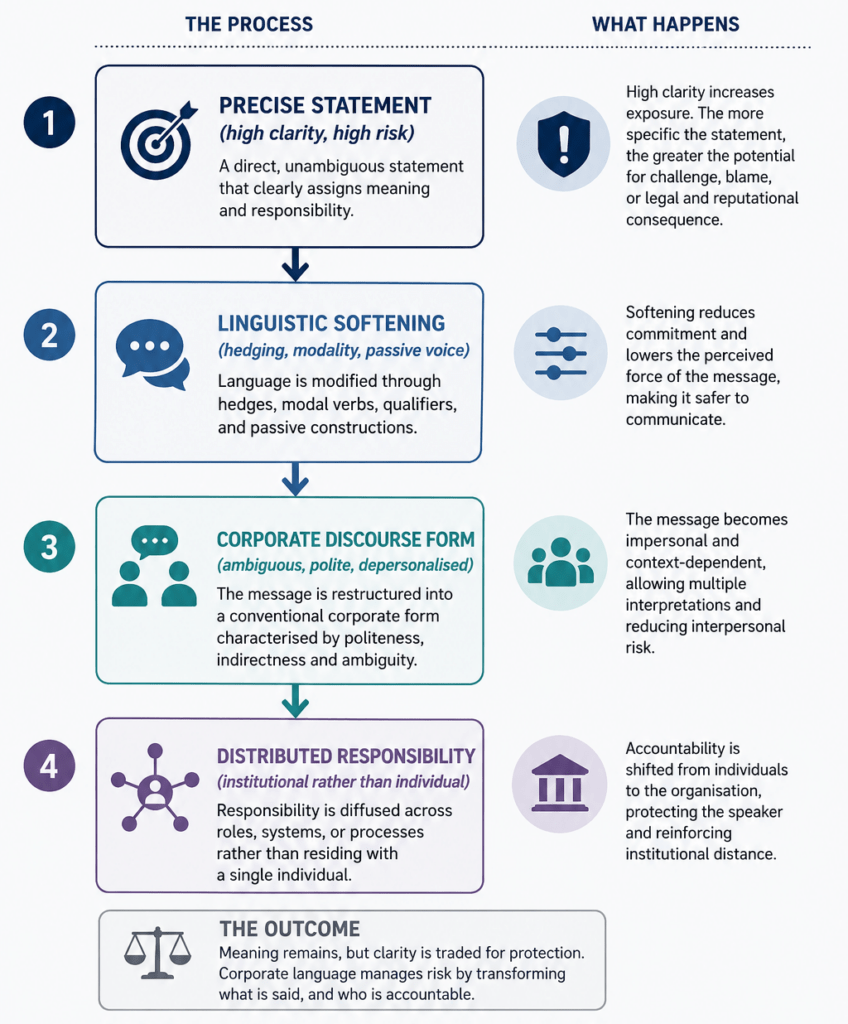
This progression illustrates how meaning is systematically transformed from direct propositional content into institutionally safe ambiguity.
This phenomenon is supported across several foundational strands of linguistic research:
- Grice (1975) – Corporate speech often flouts conversational maxims, especially Quantity and Manner, generating implicatures rather than explicit meaning.
- Brown & Levinson (1987) – Hedging functions as a politeness strategy to mitigate face-threatening acts such as disagreement or refusal.
- Hyland (1998) – Hedging is a core feature of professional and academic discourse, enabling writers to present claims cautiously under uncertainty.
- Fairclough (1992) – Institutional discourse systematically encodes power relations through linguistic abstraction and depersonalisation.
- Lakoff (1973) – Hedges reflect fuzzy boundaries in meaning, allowing speakers to adjust commitment dynamically.
Corporate language does not simply reflect uncertainty -it institutionalises it. Through hedging, modality, and passive constructions, organisations transform direct responsibility into distributed, often ambiguous, communicative structures.
In this sense, risk avoidance is not merely a communicative preference but a fundamental organising principle of corporate discourse.
The Role of Culture and Global English
In contemporary multinational organisations, English increasingly functions not as a native language, but as a lingua franca– a shared communicative medium among speakers with diverse linguistic and cultural backgrounds. This shift fundamentally alters the pragmatics of corporate communication: meaning is no longer simply encoded and decoded, but continuously negotiated across cultural expectations, institutional hierarchies, and differing norms of politeness and directness.
As Jenkins (2014) and Seidlhofer (2011) argue within the field of English as a Lingua Franca (ELF), communicative success in global settings depends less on adherence to native-speaker norms and more on mutual intelligibility and pragmatic accommodation.
English as a Lingua Franca: From Standard to Negotiated Meaning
In ELF contexts, English is not a fixed system but a flexible communicative resource. This results in a shift from grammatical correctness to pragmatic effectiveness, where clarity is often subordinated to relational and cultural considerations.
| Dimension | Native-speaker model | ELF / corporate global model |
| Primary goal | Fluency & correctness | Mutual intelligibility |
| Norm reference | Native standards | Negotiated norms |
| Error perception | Deviation | Variation |
| Pragmatic priority | Explicitness | Accommodation |
This reconceptualisation of English has significant implications for corporate communication, particularly in how indirectness, politeness, and disagreement are interpreted.
Cultural Variation in Communication Styles
One of the most significant challenges in multinational organisations is the variation in culturally embedded communication norms, particularly along the directness–indirectness spectrum.
Building on Hall’s (1976) distinction between high-context and low-context cultures, corporate misunderstandings frequently arise not from linguistic failure, but from pragmatic misalignment.
Illustrative communication styles
| Cultural Orientation | Communication Style | Typical Corporate Expression | Potential Misinterpretation |
| Low-context (e.g. Germany, Netherlands, Nordics) | Direct, explicit | “This approach will not work.” | Perceived as blunt or confrontational |
| High-context (e.g. Japan, South Korea, China) | Indirect, implicit | “This may require further consideration.” | Perceived as unclear or non-committal |
| Hybrid corporate English environments | Standardised neutrality | “We should revisit this.” | Ambiguity in intent |
Pragmatic Misinterpretation in Practice
In global organisations, miscommunication often emerges not at the lexical or grammatical level, but at the level of pragmatic inference—what speakers intend versus what hearers assume.
Common misalignment patterns
| Utterance | Intended Meaning | Possible Misinterpretation |
| “We should align on this.” | Coordination required | Either directive or vague suggestion |
| “That might be difficult.” | Strong objection | Mild concern or full rejection |
| “Let’s not rush this.” | Delay decision | Lack of urgency misunderstood as acceptance |
| Silence in meetings | Respectful disagreement | Agreement or disengagement |
| “Interesting point.” | Polite disagreement | Positive endorsement |
As House (2003) notes, ELF communication often relies on “pragmatic fluency” rather than grammatical conformity, yet this fluency is unevenly distributed across cultural groups.
High-Context vs Low-Context Corporate Friction
A useful way to conceptualise intercultural friction is through Hall’s (1976) framework:
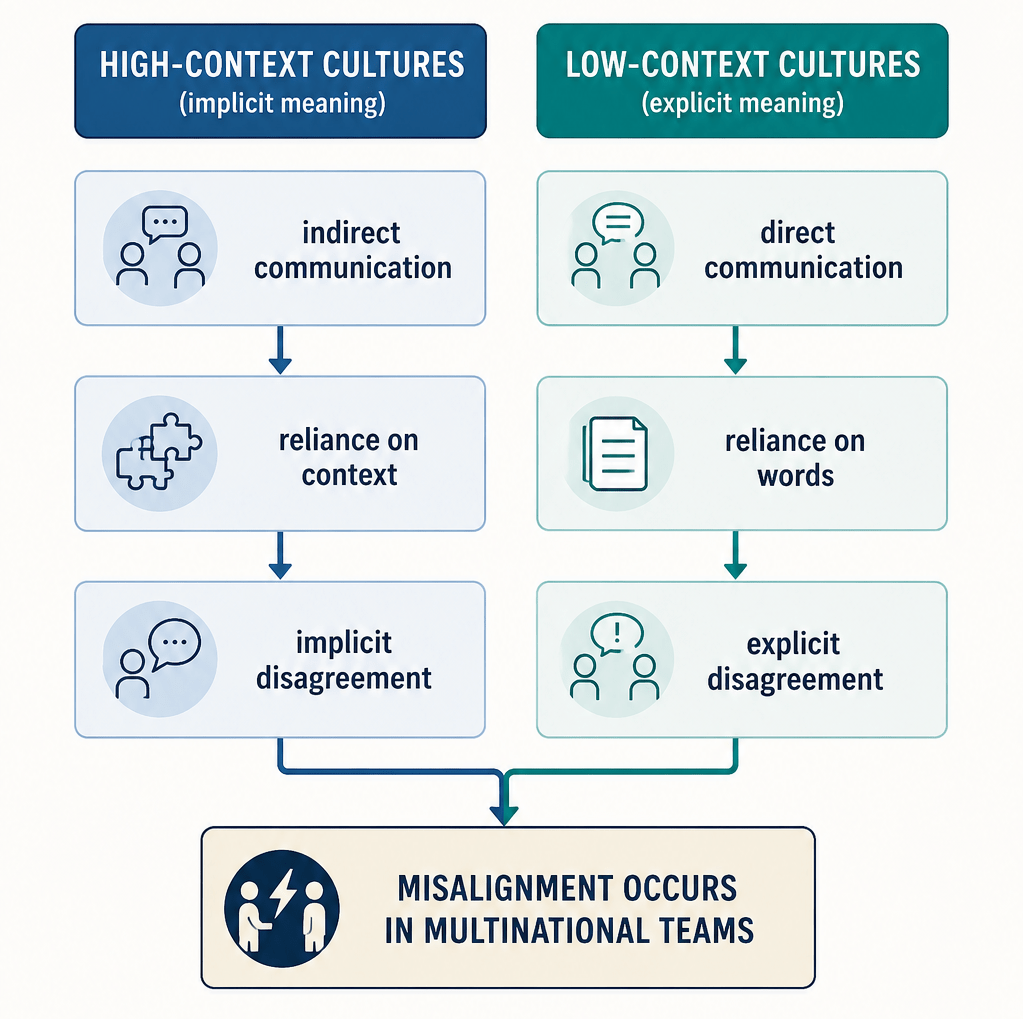
This structural mismatch often leads to systematic reinterpretation of intent, rather than simple misunderstanding.
Corporate English as a Neutralising Layer
In response to such diversity, multinational organisations often adopt a neutralised form of corporate English, characterised by:
- reduced idiomatisity
- simplified syntax
- avoidance of culturally loaded expressions
- increased reliance on formulaic politeness markers
While this improves baseline comprehension, it also produces what Cogo and Dewey (2012) describe as a “lingua franca core pragmatics”: a stripped-down communicative system optimised for stability rather than nuance.
The Paradox of Clarity and Courtesy
A central tension emerges in global corporate communication:
| Principle | Advantage | Disadvantage |
| Directness | Clarity, efficiency | Risk of perceived rudeness |
| Indirectness | Politeness, harmony | Risk of ambiguity |
| Neutral English | Accessibility | Loss of pragmatic nuance |
Thus, organisations continuously oscillate between efficiency of meaning and safety of interpretation.
Corporate language in global organisations is not merely shaped by hierarchy or institutional norms, but by a layered intercultural pragmatics, in which meaning is co-constructed across differing expectations of politeness, directness, and communicative responsibility.
As Jenkins (2014) emphasises, the primary challenge of ELF communication is not linguistic accuracy but the management of divergent pragmatic assumptions.
In this sense, misunderstandings in multinational workplaces are rarely failures of language itself; they are more accurately understood as collisions of communicative cultures operating through a shared but differently interpreted linguistic medium.
AI and the Standardisation of Corporate Speech
The integration of artificial intelligence into workplace communication – particularly through email assistants, report generators, and enterprise writing tools- marks a significant shift in the evolution of corporate language. Whereas organisational discourse was once shaped primarily by hierarchy, culture, and professional convention, it is now increasingly mediated by algorithmically generated linguistic norms.
From a discourse-analytic perspective, this development extends earlier tendencies towards standardisation (Fairclough, 1992), but accelerates them through scale, speed, and statistical reinforcement. AI systems trained on large corpora of professional writing tend to reproduce what is most frequent, rather than what is most contextually appropriate, resulting in a form of language that is syntactically polished yet pragmatically flattened.
The Emerging AI Corporate Register
AI-assisted writing tends to converge towards a recognisable “corporate neutral style”, characterised by:
- grammatical correctness
- polite hedging
- formulaic politeness markers
- reduced idiomatic variation
- emotionally neutral tone
Example transformation
| Human draft | AI-generated version | Pragmatic shift |
| “This plan is messy and won’t work.” | “There may be some challenges with this approach.” | Strong critique → hedged suggestion |
| “We need to fix this immediately.” | “This may require prompt attention.” | Urgency → softened priority |
| “I don’t agree with this proposal.” | “I have some reservations regarding this proposal.” | Direct disagreement → diplomatic ambiguity |
| “This is confusing.” | “This could benefit from further clarification.” | Evaluation → neutral reframing |
These transformations reflect what Goffman’s (1959) theory of impression management would describe as systematic face-work optimisation, now automated at scale.
Standardisation Through Statistical Language Modelling
Large language models (LLMs) generate outputs based on probabilistic patterns derived from training data. As a result, they tend to:
- privilege high-frequency corporate formulations
- avoid low-frequency but contextually precise expressions
- reinforce conventional politeness strategies
- minimise linguistic risk-taking
This creates what may be termed a “statistical corporate normativity”, where language is shaped not by intention, but by likelihood.
Benefits and Risks of AI-Mediated Corporate Communication
| Dimension | Benefit | Risk |
| Clarity | Improved grammatical correctness and coherence | Over-simplification of complex meaning |
| Efficiency | Faster drafting and editing | Reduced deliberation in communication |
| Consistency | Unified organisational tone | Loss of individual voice |
| Risk management | Reduced offensive or ambiguous phrasing | Excessive hedging and vagueness |
| Scalability | Large-scale communication standardisation | Cultural and contextual flattening |
This trade-off reflects a broader tension between linguistic optimisation and pragmatic richness.
From Pragmatic Flexibility to Synthetic Neutrality
One of the most significant consequences of AI-assisted writing is the emergence of what can be described as synthetic neutrality – a communicative style that is:
- formally correct
- socially inoffensive
- emotionally restrained
- pragmatically under-specified
While such language reduces interpersonal friction, it also risks weakening the inferential richness that human interlocutors rely on to interpret intent.
Conceptual Model: AI and Linguistic Convergence
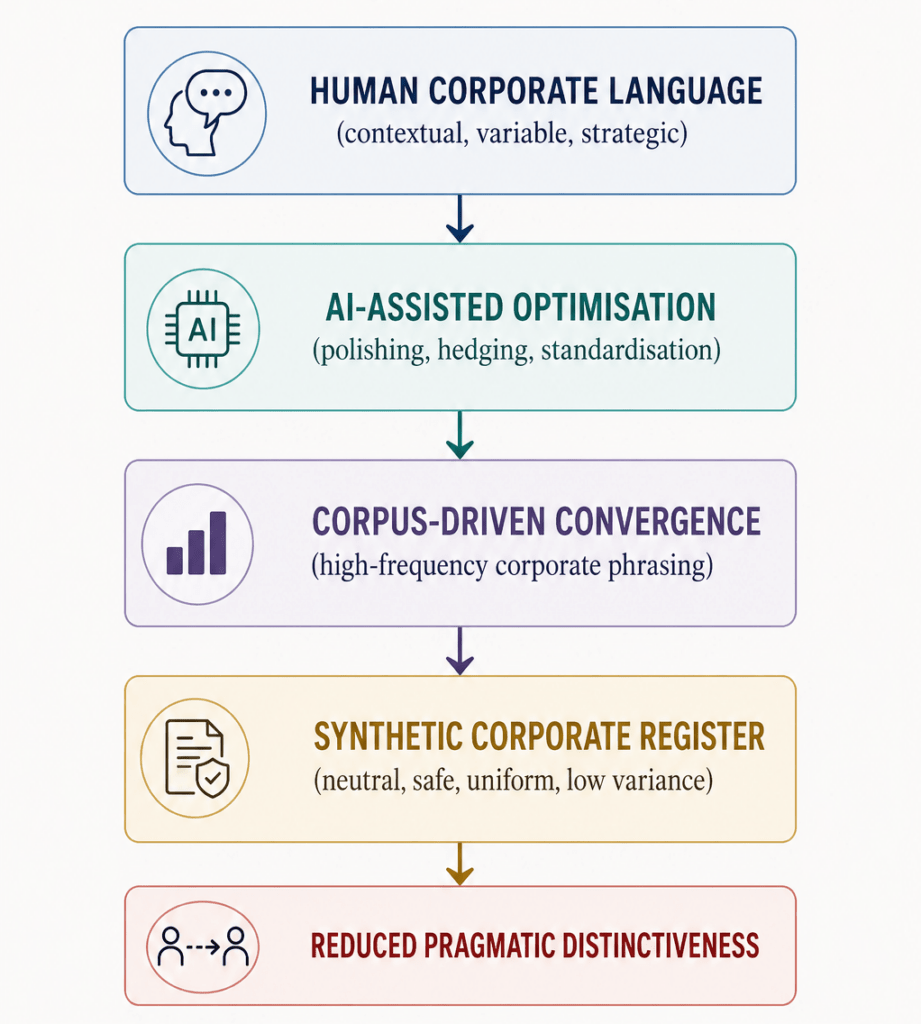
This model illustrates how AI does not simply assist communication – it actively compresses linguistic variability towards statistically dominant forms.
Scholarly Context: Language, Technology, and Standardisation
This phenomenon aligns with broader research across linguistics and media studies:
- Fairclough (1992) argues that discourse is shaped by institutional and technological forces that standardise communication practices.
- Gillespie (2014) highlights how algorithmic systems embed normative assumptions into communicative infrastructures.
- Goffman (1959) provides a foundation for understanding communication as managed performance, now increasingly automated.
- Hutchins & Somers (1992) in machine translation studies demonstrate early forms of linguistic simplification driven by computational constraints.
- Kitchin (2017) describes algorithmic systems as producing “data-driven rationalities” that prioritise consistency over contextual sensitivity.
Together, these works suggest that AI does not merely reflect corporate language – it actively reconfigures its stylistic and pragmatic boundaries.
The Paradox of AI Communication in Organisations
A central paradox emerges in AI-mediated corporate discourse:
- It improves surface-level communication quality (grammar, coherence, politeness)
- Yet simultaneously reduces deep-level communicative precision (intent, stance, nuance)
| Dimension | Pre-AI Corporate Speech | AI-Augmented Speech |
| Stylistic variation | High | Low |
| Pragmatic clarity | Context-dependent | Often diluted |
| Individual voice | Distinct | Homogenised |
| Risk of offence | Moderate | Minimal |
| Interpretive richness | High | Reduced |
This leads to what may be termed a “flattening of organisational voice”, where communication becomes more uniform but less semantically dense.
AI-driven corporate communication does not eliminate ambiguity – it redistributes it. While linguistic surface form becomes more polished and consistent, pragmatic ambiguity shifts from wording to interpretation, requiring greater reliance on contextual inference by recipients.
In this sense, AI does not simply optimise corporate language; it subtly transforms it into a standardised, statistically moderated discourse system, optimised for safety, scalability, and acceptability rather than expressive precision.
Conclusions
Corporate language, in all its indirectness, hedging, cultural variation, and algorithmic refinement, reveals something paradoxical: the more organisations strive for clarity, efficiency, and neutrality, the more their language becomes interpretive rather than explicit.
Meaning is not lost, it is redistributed. Across hierarchy, across cultures, and increasingly across machines, communication becomes a shared act of inference rather than a transfer of information.
To understand corporate language, then, is to understand not what is said, but what is managed, softened, displaced, and algorithmically normalised beneath it.
And perhaps the real question is no longer whether we understand organisations, but whether we understand the language systems that quietly govern how organisations think.
Are you Eng-sighted?
References
- Bargiela-Chiappini, F., & Nickerson, C. (1999). Writing Business: Genres, Media and Discourses. Longman.
- Brown, P., & Levinson, S. C. (1987). Politeness: Some Universals in Language Usage. Cambridge University Press.
- Cogo, A., & Dewey, M. (2012). Analysing English as a Lingua Franca: A Corpus-Based Investigation. Continuum.
- Fairclough, N. (1992). Discourse and Social Change. Polity Press.
- Gillespie, T. (2014). The relevance of algorithms. In Media Technologies: Essays on Communication, Materiality, and Society. MIT Press.
- Goffman, E. (1959). The Presentation of Self in Everyday Life. Anchor Books.
- Goffman, E. (1967). Interaction Ritual: Essays on Face-to-Face Behaviour. Anchor Books.
- Grice, H. P. (1975). Logic and conversation. In P. Cole & J. L. Morgan (Eds.), Syntax and Semantics 3: Speech Acts. Academic Press.
- Gunnarsson, B.-L. (2009). Professional Discourse. Continuum.
- Hall, E. T. (1976). Beyond Culture. Anchor Books.
- House, J. (2003). English as a lingua franca: A threat to multilingualism? Journal of Sociolinguistics, 7(4), 556–578.
- Hyland, K. (1998). Hedging in Scientific Research Articles. John Benjamins.
- Jenkins, J. (2014). English as a Lingua Franca in the International University. Routledge.
- Kecskes, I. (2015). English as a Lingua Franca: Theoretical Considerations. Cambridge University Press.
- Kitchin, R. (2017). Thinking critically about and researching algorithms. Information, Communication & Society, 20(1), 14–29.
- Lakoff, G. (1973). Hedges: A study in meaning criteria and the logic of fuzzy concepts. Journal of Philosophical Logic, 2(4), 458–508.
- Seidlhofer, B. (2011). Understanding English as a Lingua Franca. Oxford University Press.
- Searle, J. R. (1969). Speech Acts: An Essay in the Philosophy of Language. Cambridge University Press.
Leave a Reply